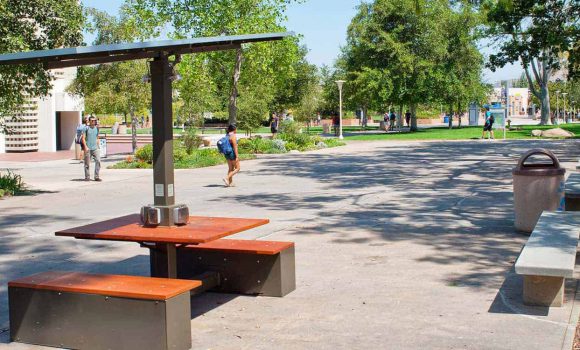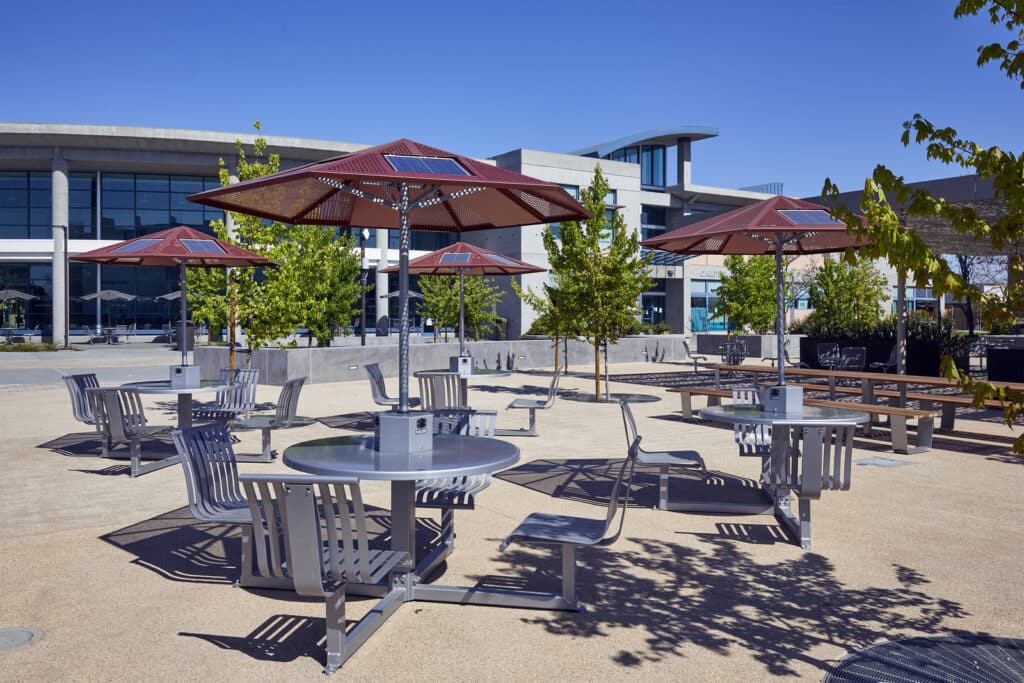
Solar in 2026 is moving from one-off rooftop projects to integrated, visible infrastructure that supports work, learning, and public life, with corporate campuses, schools, and cities using solar to meet climate goals and resilience needs. Sunbolt solar workstations fit this shift perfectly by turning outdoor spaces into productive, off‑grid, solar‑powered hubs that showcase sustainability while delivering everyday utility.
Major Solar Trends in 2026
- Governments are expanding grants, tax credits, and low-interest financing for on-site solar and storage, especially for schools, municipalities, and community-serving campuses.
- Solar is increasingly paired with batteries and smart controls so organizations can manage demand, support resilience, and keep key services running during outages.
- New technologies such as high-efficiency panels, transparent PV for facades, and AI-optimized systems are moving from pilots into real-world buildings and campuses.
Corporate Campuses & Businesses
Corporate real estate teams are using solar not only on roofs but across plazas, courtyards, and parking areas to create visible ESG assets that employees actually use. Sunbolt solar workstations turn underused outdoor areas into shaded collaboration zones with integrated PV, batteries, and device charging, all without adding to building peak load.
Ways businesses can leverage these workstations in 2026:
- Deploy solar tables across campus walkways and courtyards as bookable outdoor meeting and focus work areas that count toward sustainability and wellness goals.
- Use data from workstation utilization and energy generation to report on carbon reduction and support green building or corporate ESG disclosures.
Schools & Universities
K‑12 districts and universities are targeted by many 2026 clean energy grants and state-level programs, often prioritizing projects that combine learning, resilience, and community benefit. Solar workstations on quads, bus loops, and outdoor study areas give students reliable device charging, shade, and lighting while running entirely on renewable energy.
Schools are going solar at a rapid pace, with over 9,000 U.S. buildings now equipped—doubling since 2014. In 2026, this trend accelerates, saving districts millions while reducing emissions equivalent to removing hundreds of thousands of cars from roads.
Programs like Pennsylvania’s Solar for Schools are funding installations, helping schools lower energy costs and teach sustainability. Rooftop arrays on 5,000 Pennsylvania schools alone could power 187,000 homes annually.
Program ideas for education:
- Create “outdoor classrooms” where solar tables power laptops, lab sensors, and AV equipment, tying real-time production data into STEM and environmental curricula.
- Include solar workstations in safety and resilience planning by placing them near evacuation zones or gathering points as off‑grid communication and charging hubs.
Government Grants & Public Spaces
Cities and counties in 2026 can tap a mix of federal, state, and utility programs that fund on-site renewables, resilience hubs, parks improvements, and equitable access to clean energy. Because solar workstations are modular outdoor infrastructure, they can often qualify under line items for public realm upgrades, EV and device charging, and resilience or community solar initiatives.
Grant-aligned deployment ideas:
- Install solar workstations in libraries, transit centers, and parks as highly visible proof of grant impact, supporting digital equity and safe evening use through integrated lighting.
- Bundle multiple sites—schools, civic plazas, and recreation areas—into one grant application to show citywide climate and community benefit from distributed solar amenities.
Advanced Solar Tech & Sunbolt Solutions
Cutting-edge solar in 2026 includes transparent and building-integrated PV, higher-efficiency modules above 20–25%, and sensor-rich, AI-managed systems that optimize production and usage across a site. Solar workstation platforms align with this direction by combining PV, battery storage, smart inverters, and connected monitoring into human-centered products that plug into broader campus energy strategies.
To meet 2026 solar goals, innovative products like Sunbolt workstations are essential. These off-grid, NEC-compliant units deliver reliable power for charging laptops, tablets, and phones using high-output solar panels and battery banks. Ideal for corporate campuses, schools, and businesses, they enhance outdoor spaces while promoting sustainability.
How to use workstations to hit 2026 solar goals:
- Treat outdoor solar workstations as quick-win “micro projects” that demonstrate progress while slower roof or carport projects move through design and permitting.
- Integrate workstation performance into a campus energy dashboard to engage stakeholders, guide expansion plans, and support continuous improvement of sustainability targets.
More interesting facts (source):
- Global solar installations peak after record 2025
- Data center demand for electricity soars
- China’s solar additions decline by 33%
Looking to add solar workstations to your campus? Contact us today!